Create an extremely photorealistic professional traditional Indian saree portrait. This is a STRICT REFERENCE-MATCHING TASK, not a creative redesign. Use the woman's original reference photograph exclusively to preserve her facial identity. Also use the supplied saree portrait reference as the exact visual blueprint for the saree, blouse, jewellery arrangement, hairstyle, standing angle, body position, architectural location, background, camera framing, and lighting. Do not reinterpret or redesign any of these elements.
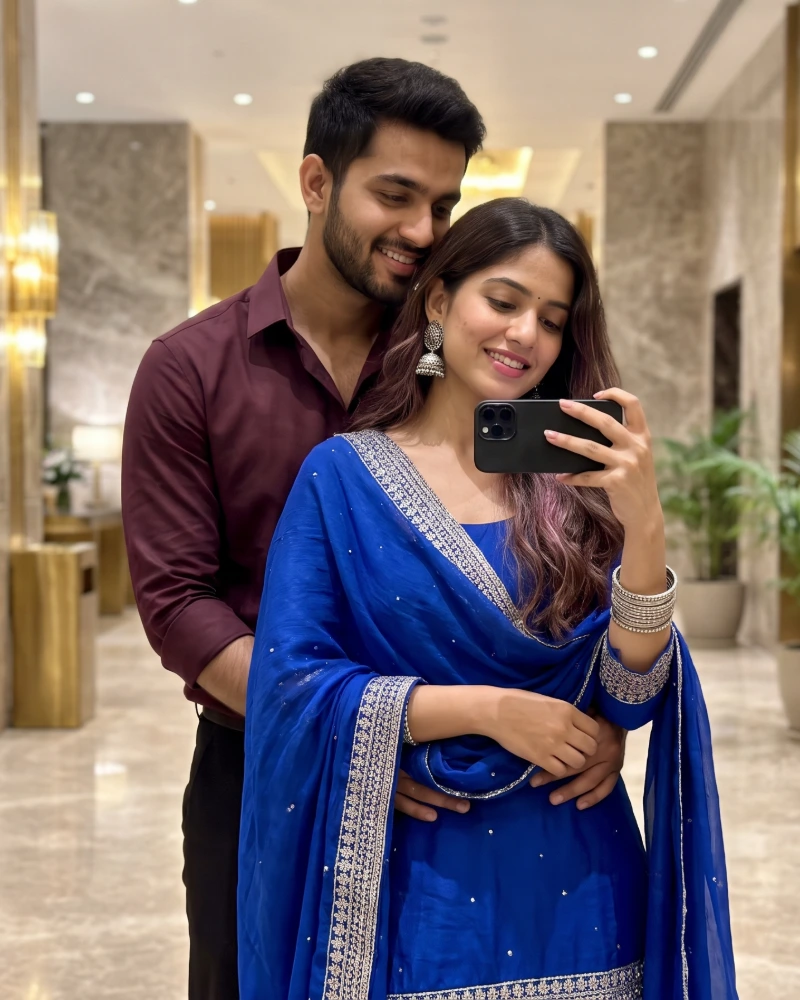
IDENTITY: Preserve the woman's exact facial identity from her identity reference photograph. Keep her original facial structure, eyes, nose, lips, eyebrows, jawline, skin tone, and natural facial proportions. Do not substitute a different face, blend identities, or apply artificial beauty filters.
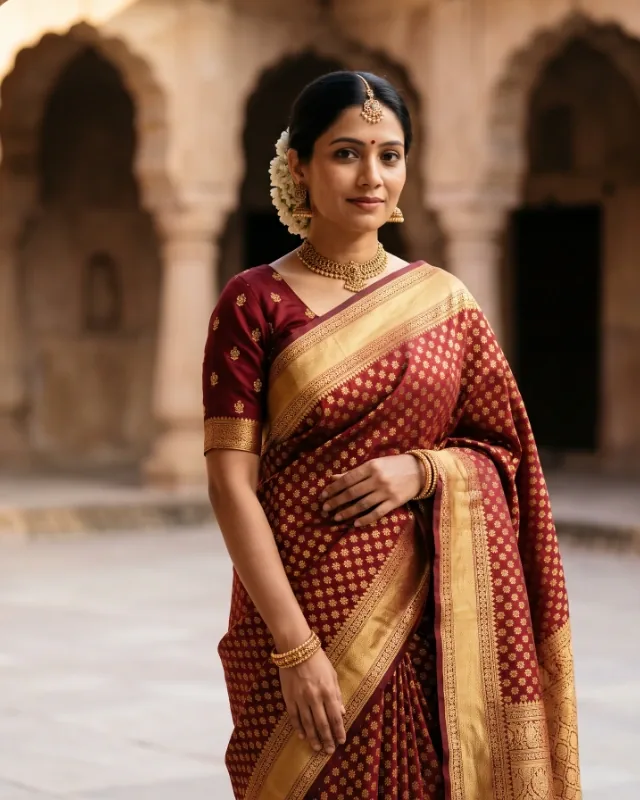
EXACT SAREE DESIGN — DO NOT CHANGE: The woman must wear the same deep maroon-red traditional silk saree shown in the visual reference. It has a rich antique-gold woven zari design, with small repeating gold floral motifs across the maroon fabric. The saree has a distinctive broad golden border with intricate traditional patterns. A wide golden section crosses diagonally over the upper chest from the shoulder, exactly as shown in the reference. The pallu is draped over the LEFT shoulder and falls down the front of the body, with its broad gold patterned border clearly visible. Preserve the same arrangement of the maroon patterned silk, golden diagonal chest section, and wide gold pallu border. The lower saree has natural pleats in the same maroon-and-gold fabric.
The blouse must remain exactly the same style: deep maroon, short sleeves, fitted traditional blouse, with small gold embroidered motifs and a narrow gold embroidered sleeve border. Do not change the blouse neckline, sleeve length, colour, embroidery, or design.
ABSOLUTE SAREE CONSISTENCY: The saree is not interchangeable. Never generate a different saree, colour, fabric, border, pattern, motif, pallu arrangement, or draping style. Do not turn it into a plain saree, a red-and-yellow saree, a gold-dominant saree, a green saree, or a different regional style. Do not invent new embroidery. Match the reference garment's visual appearance as closely as possible in every generation.
EXACT JEWELLERY AND HAIRSTYLE: Keep the same traditional antique-gold choker necklace, matching gold jhumka earrings, central maang tikka, small dark-red bindi, and gold bangles. Her black hair is centre-parted, neatly tied into a low bun, and decorated with a compact arrangement of white jasmine flowers behind the ear. Do not add or remove jewellery, change the jewellery design, or change the hairstyle.
EXACT STANDING ANGLE AND POSE: Reproduce the same standing position as the reference. The woman stands upright, facing almost directly toward the camera, with her body turned only slightly at the same angle as the reference. Her head faces the camera. Her shoulders remain relaxed. She looks directly into the camera with a calm, gentle, natural expression and a subtle smile. One hand rests gently across the saree at waist level, holding the fabric naturally. The other arm hangs relaxed in front of her body, with the hand positioned near her upper thigh. Preserve the same arm positions, hand positions, body orientation, head angle, and posture in every generation. Do not create a three-quarter fashion pose, side profile, walking pose, seated pose, or different hand gesture.
EXACT LOCATION: The setting is the same traditional Indian sandstone palace courtyard shown in the reference. A large, intricately carved sandstone pillar fills the LEFT foreground, extending vertically along the left edge of the composition. Behind the woman are tall sandstone columns and repeated rounded stone arches. The architecture is warm beige and sandy brown, with authentic carved details. The pale stone courtyard floor is visible in the lower background. The arches recede into the distance, creating the same depth and perspective as the reference. The location must remain this exact type of courtyard with the same arrangement of architectural elements. Do not replace it with a palace room, modern building, garden, temple interior, doorway, or another heritage location.
EXACT LIGHTING: Soft, warm natural late-afternoon sunlight enters from the upper-left side of the courtyard. It illuminates the woman's face, maroon silk, and gold jewellery naturally. The sandstone pillars receive warm sunlight, while the arches behind her have gentle natural shadows. Maintain realistic daylight exposure, natural skin tones, and balanced highlights. Do not use artificial orange filters, dramatic studio lighting, excessive glow, or cinematic colour grading.
EXACT CAMERA AND FRAMING: Horizontal 4:3 aspect ratio. Reproduce the reference image's camera perspective and composition. The woman stands slightly right of the centre. The large carved pillar occupies the left edge. The sandstone arches remain visible behind her. Frame from the top of her head to approximately mid-thigh, with enough room around her to show the architecture. Use an eye-level camera position and a natural 85mm portrait-lens perspective. Keep the woman at the same apparent distance and scale as in the reference. Her face, jewellery, and saree must be sharply focused. The background is softly out of focus but clearly recognizable.
REAL PHOTOGRAPH REQUIREMENT: The result must look like a genuine photograph taken by a professional photographer at a real sandstone heritage courtyard. Preserve realistic skin pores, fine facial details, natural hair strands, authentic silk texture, physically accurate woven gold embroidery, natural fabric folds, realistic jewellery reflections, and anatomically correct hands. Avoid plastic-looking skin, excessive smoothing, artificial facial symmetry, exaggerated makeup, and digitally enhanced beauty. Keep the woman's real appearance.
FIXED GENERATION SETTINGS: Use the same identity reference photograph and the same saree/location reference image for every generation. Keep their reference order and reference-strength settings unchanged. Use the same image-generation model and version, the same exact prompt, the same negative prompt, horizontal 4:3 aspect ratio, and the same resolution. If supported, use the fixed seed 684219 for every run. Set identity reference strength to high, visual reference or image guidance strength to high, prompt adherence to high, stylization to minimum, and creativity to low. Disable automatic redesign, random styling, and scene variation. Do not change any settings between generations.
STRICT REFERENCE LOCK: The saree must look the same in every image. The blouse must look the same. The jewellery must remain the same. The hairstyle must remain the same. The woman's standing angle and hand positions must remain the same. The sandstone courtyard, carved pillar on the left, repeated arches, background perspective, lighting direction, camera position, and framing must remain the same. Treat the saree and location reference as fixed visual references, not loose inspiration. Do not make independent creative decisions about the clothing, pose, or environment.
NEGATIVE PROMPT: Different saree, redesigned saree, different saree colour, plain saree, green saree, bright red saree, yellow saree, different gold border, narrow border, missing gold border, changed embroidery, random floral patterns, different blouse, different blouse neckline, sleeveless blouse, changed sleeve length, different pallu position, altered saree pleats, modern clothing, different jewellery, extra necklaces, missing maang tikka, oversized jewellery, changed hairstyle, missing jasmine flowers, different standing angle, side profile, three-quarter pose, walking, sitting, different hand placement, different body position, different courtyard, modern architecture, palace room, garden, temple interior, different pillar arrangement, missing left foreground pillar, missing arches, different camera angle, different framing, different subject scale, generic face, identity change, face swapping, distorted facial features, plastic skin, excessive retouching, malformed hands, extra fingers, fused fingers, unrealistic fabric, artificial gold shine, CGI, illustration, painting, fantasy effects, cinematic lighting, artificial orange filter, and excessive colour grading.