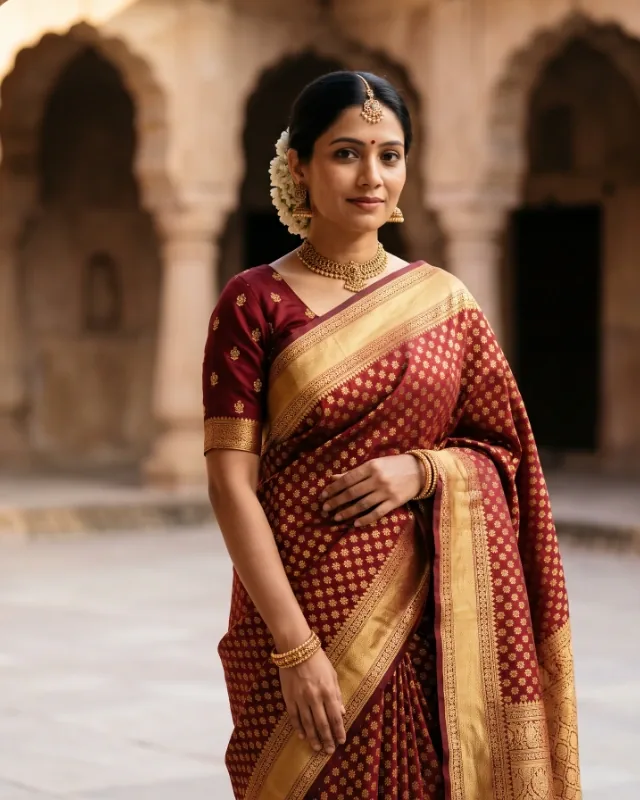
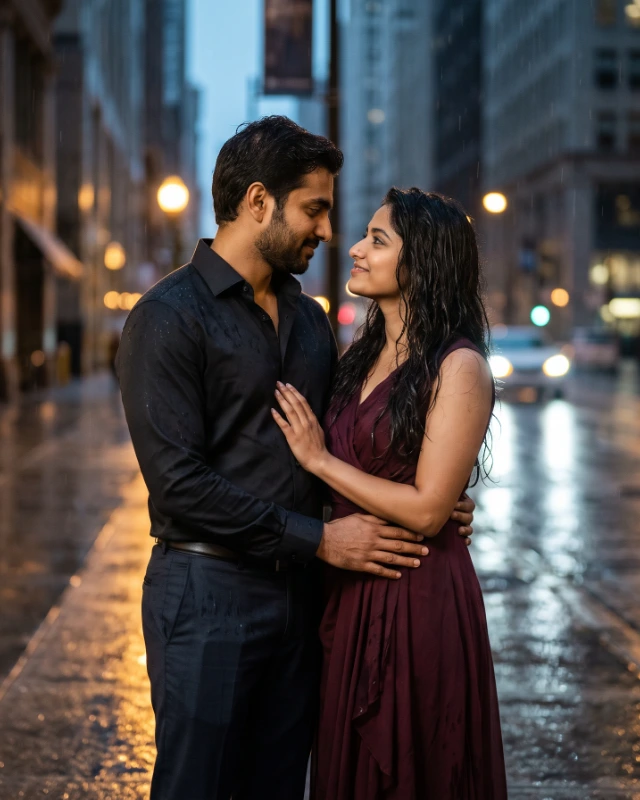
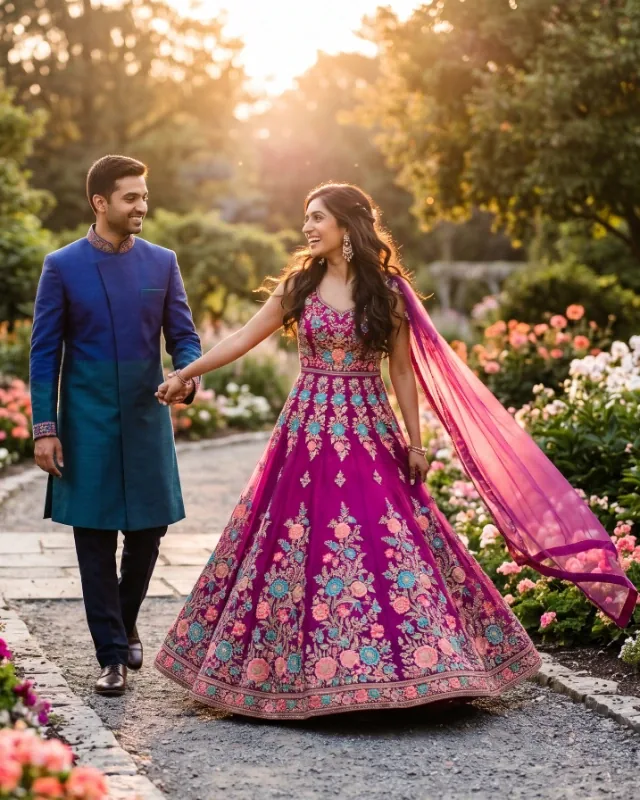
Create an extremely realistic professional mirror-selfie photograph of an Indian couple, reproducing the exact composition, pose, outfits, expressions, location, lighting, and camera framing described below. This is a strict visual-reference matching task, not a creative redesign. Use the supplied couple reference photographs to preserve each person's individual facial identity. Keep the man's identity and the woman's identity completely separate and accurate. Do not blend their facial features, replace either face, or turn them into generic models.
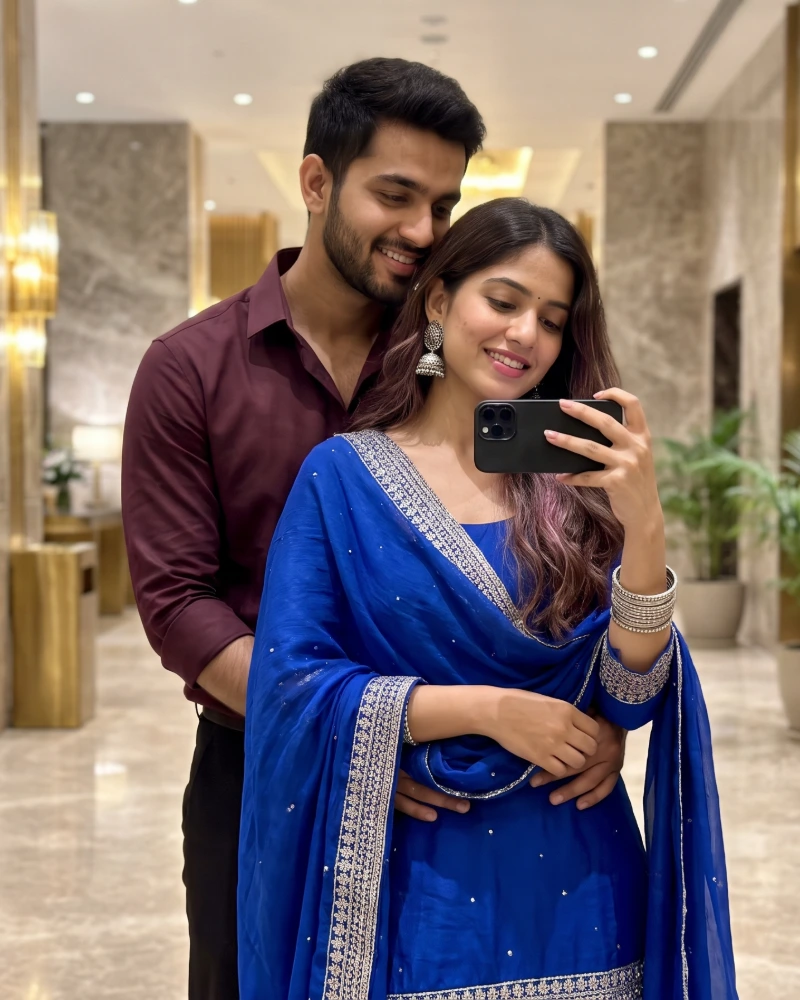
The scene takes place inside one specific location: an elegant modern luxury hotel lobby with polished cream marble flooring, tall beige-grey marble pillars, narrow vertical gold metallic trims, warm recessed ceiling lights, and large indoor green plants in beige stone planters. The couple is standing directly in front of a large full-length mirror. The mirror reflects the hotel lobby behind them, including the marble pillars, gold details, indoor plants, and warm ceiling lights. The background must remain the same refined hotel interior in every generation. Do not substitute a palace, bedroom, living room, outdoor location, or different hotel design.
The woman stands in the FRONT, positioned in the centre of the composition and slightly toward the RIGHT. The man stands directly BEHIND her, positioned slightly toward the LEFT. Their bodies are close together. The man gently embraces the woman around her waist from behind, with both arms naturally positioned around her midsection. His hands rest gently across the front of her waist, partially visible over her outfit. The woman holds a black smartphone in her RIGHT hand, raising it to approximately chest-to-face height to take a mirror selfie. The phone is held vertically, with its rear camera facing the mirror. Her right elbow is naturally bent. Her LEFT forearm rests horizontally across her waist, with her left hand relaxed over the front of her outfit. Both maintain a natural, affectionate posture.
The woman's head tilts slightly downward and toward her RIGHT, with her eyes looking at the smartphone screen. She has a relaxed, genuine smile. The man stands close behind her, his head leaning slightly toward the woman's head from her LEFT side. He looks downward toward her face or the phone screen with a warm, natural smile. Their faces remain clearly visible in the mirror. Keep their expressions subtle and authentic, not exaggerated.
WOMAN'S OUTFIT — EXACT SALWAR KAMEEZ, NOT A SAREE: The woman wears a traditional royal-blue Punjabi-style salwar kameez. The outfit consists of a royal-blue kameez (long tunic), matching royal-blue salwar trousers, and a matching royal-blue dupatta. The kameez has a modest rounded neckline, fitted short sleeves, and delicate silver embroidery along the neckline, sleeve edges, and selected decorative sections. The fabric is rich deep royal blue, with tiny subtle silver embellishments scattered across it. The matching dupatta is draped over her LEFT shoulder and falls naturally across the front of her body, with a clearly visible, intricate silver embroidered border. Its other section falls naturally along her side. The dupatta must look like a separate lightweight fabric piece, not a saree pallu. The kameez must remain a distinct long tunic, not a saree blouse. The matching salwar trousers must remain part of the outfit, even where they are outside the camera crop. Preserve the exact royal-blue colour, silver border, embroidery, fabric appearance, neckline, sleeve length, and dupatta arrangement in every generation.
IMPORTANT CLOTHING LOCK: This is a three-piece salwar kameez outfit: kameez, salwar trousers, and dupatta. It is NOT a saree, NOT a lehenga, and NOT a gown. Do not create saree pleats, a saree pallu, a waist-wrapped saree, or a saree blouse. Do not change the outfit into another style or colour. The dupatta must remain draped over the LEFT shoulder exactly as described.
The woman has long, naturally wavy dark-brown hair, worn loose over her shoulders and down her back. Her hair has realistic individual strands and natural volume. She wears elegant medium-sized silver jhumka earrings and several coordinated silver bangles on her RIGHT wrist. Keep the jewellery minimal and consistent. Do not add a necklace, maang tikka, bindi, extra jewellery, or different ornaments.
The man wears exactly one dark burgundy-maroon casual formal shirt with a soft natural fabric texture, a simple open collar, and sleeves rolled neatly to his forearms. He wears black trousers. His shirt remains naturally fitted as shown in the reference. Do not change his outfit to a sherwani, suit, kurta, blazer, or traditional wedding outfit. Preserve his original hairstyle and facial hair exactly as shown in his identity reference.
The lighting is warm, soft, and natural-looking, created by the hotel lobby's warm recessed ceiling lights and ambient interior illumination. The couple's faces must be clearly exposed, with natural skin tones and soft realistic shadows. The polished marble surfaces and gold metallic details should reflect the indoor lighting naturally. Avoid excessive yellow colour grading, artificial glow, dramatic spotlights, or cinematic effects.
Use a fixed horizontal 4:3 aspect ratio. Reproduce the reference photograph's mirror-selfie perspective and framing. The couple occupies the central area of the image, with the woman in front and the man immediately behind her. Frame them from approximately the waist or upper thighs upward, while retaining enough background to show the marble pillars, gold trims, plants, and hotel lobby. Keep the smartphone visible in the woman's RIGHT hand. The mirror reflection must look physically accurate, with no duplicated people or inconsistent reflections. Use a natural 50mm photographic perspective at approximately eye level. Both faces, the royal-blue salwar kameez, the man's maroon shirt, and the couple's embrace must be clearly detailed.
The final result must look like an actual photograph taken by a person using a smartphone in a hotel mirror. Preserve realistic skin pores, fine facial details, natural hair texture, accurate fabric folds, authentic silver embroidery, realistic jewellery, correct hand anatomy, and physically accurate mirror reflections. Do not make the image look like a professional fashion campaign, movie scene, illustration, or artificial AI portrait. It should feel like a genuine spontaneous couple selfie taken in a beautiful hotel lobby.
STRICT OUTFIT LOCK: The woman's outfit must always remain the exact same royal-blue salwar kameez with matching salwar trousers and a separate royal-blue dupatta featuring the same silver embroidered border and small silver embellishments. The dupatta must remain over her LEFT shoulder. Never convert it into a saree or add saree pleats. The man's outfit must always remain the same burgundy-maroon shirt and black trousers. Do not alter either person's clothing, colour, design, fabric, or accessories.
STRICT POSE LOCK: The woman must always stand in front, holding the same black smartphone vertically in her RIGHT hand. Her LEFT forearm remains across her waist. The man must always stand immediately behind her, slightly to the LEFT, embracing her waist with both arms. Preserve their exact relative positions, head angles, body angles, hand placement, expressions, and distance between them. Do not reverse their positions or create a different embrace.
STRICT LOCATION LOCK: Always reproduce the same luxury hotel lobby with cream marble floors, beige-grey marble pillars, vertical gold metallic trims, warm recessed ceiling lights, and green indoor plants in beige planters. Keep the same mirror-selfie viewpoint, background arrangement, architectural perspective, and lighting. Never generate a different location or background.
REUSABLE GENERATION SETTINGS: Use the same two individual identity reference photographs in the same order for every generation. Use the uploaded couple photograph as the fixed visual reference for composition, outfits, pose, location, and framing. If separate face-reference controls are available, assign each person's identity photograph to the correct person independently. Use the same image-generation model and version, same reference images, same reference order, same prompt wording, same negative prompt, same horizontal 4:3 aspect ratio, and same output resolution every time. If supported, use a fixed seed of 628415. Set identity-reference strength to high, visual-reference strength to high, prompt adherence to high, stylization to minimum, and creativity to low. Disable random styling, automatic clothing redesign, pose variation, and background variation. Keep all available generation settings unchanged between runs.
NEGATIVE PROMPT: Saree, saree pallu, saree pleats, saree blouse, lehenga, gown, skirt, different outfit, different salwar kameez, different outfit colour, purple outfit, red outfit, green outfit, missing salwar trousers, missing dupatta, changed dupatta placement, dupatta wrapped like a saree, gold embroidery, random patterns, missing silver border, different blouse neckline, different sleeve length, different jewellery, extra necklace, oversized earrings, different hairstyle, short hair, different man's shirt, different shirt colour, sherwani, suit, blazer, different trousers, reversed couple positions, woman behind man, man beside woman, different embrace, changed hand positions, phone in left hand, horizontal phone, missing phone, extra phones, duplicated people, incorrect mirror reflection, distorted mirror, extra arms, malformed hands, extra fingers, fused fingers, distorted wrists, unnatural body proportions, stiff pose, exaggerated expressions, artificial smiles, different hotel, palace background, bedroom, garden, outdoor setting, missing marble pillars, missing gold trims, missing indoor plants, cluttered background, wide-angle distortion, incorrect camera framing, harsh flash, plastic skin, excessive retouching, artificial beauty filter, overexposure, excessive yellow tint, cinematic colour grading, lens flare, illustration, painting, CGI, and 3D-rendered appearance.